
Estimated reading time: 6 minutes
Most of us have probably had the experience of looking back at something we said, did or decided and wondering:
Why on earth did I do that?
Perhaps you reacted far more strongly than the situation seemed to warrant. You made a decision you later regretted. You couldn’t think clearly when you needed to. Or you knew exactly what you should do, yet somehow found yourself doing something completely different.
It is easy to interpret experiences like these as failures of intelligence, judgement or self-control.
But there may be another way of understanding them.
Having intelligence isn’t the same as having access to it
We tend to think about intelligence as something we possess.
You are intelligent or you aren’t. You know something or you don’t. You have good judgement or poor judgement.
Real life is considerably messier.
A person can be thoughtful, perceptive and capable in one situation, then find those same qualities much harder to access when they are stressed, emotionally activated, overwhelmed, frightened, exhausted or under pressure.
The intelligence hasn’t necessarily disappeared.
Our access to it has changed.
This distinction sits at the heart of a framework I have been developing from Unmachine Your Mind called Psychernetics, which explores human intelligence not simply in terms of what we possess, but how much of it remains available to us when we actually need it.
I call this Available Intelligence.
What happens to you under pressure?
Think about yourself when you are calm, rested and feeling relatively secure.
Now compare that person with you during an argument, a crisis, an important decision, a period of uncertainty or a particularly stressful day.
You may notice some interesting differences.
Perhaps your thinking becomes narrower. Maybe emotions become more difficult to interpret. You might lose perspective, become unusually certain about something, struggle to make sense of what is happening or simply go into autopilot.
This matters because some of the most consequential moments of our lives don’t happen when we are sitting quietly with unlimited time to think.
They happen when something is at stake.
So perhaps one of the most useful questions in personal development isn’t simply:
How intelligent am I?
It is:
How much of my intelligence is available to me when I need it most?
Four capacities that influence what is available
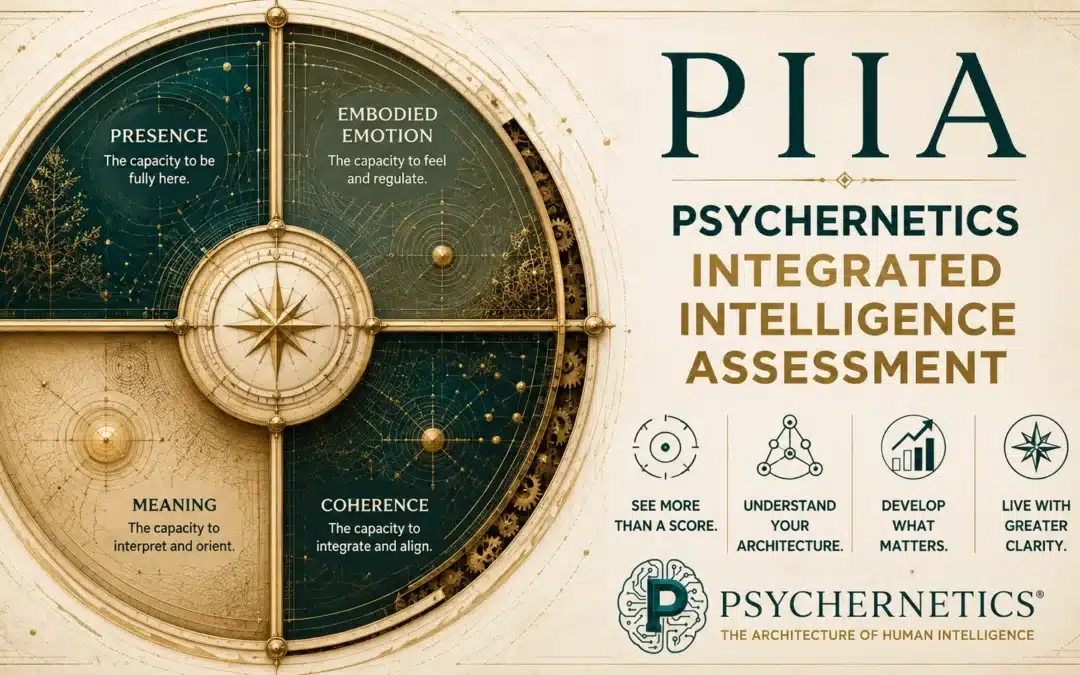
Psychernetics explores this through four interconnected human capacities:
Presence – our capacity to remain sufficiently present rather than becoming captured by distraction, reactivity or automatic behaviour.
Embodied Emotion – our capacity to recognise and work with emotional and bodily information rather than simply being driven by it.
Meaning – our capacity to interpret experience, understand context and recognise what genuinely matters.
Coherence – our capacity to bring these different forms of information together sufficiently well to think, judge and act.
Importantly, these aren’t personality types.
They can become more or less available depending upon circumstances.
That means the question isn’t simply “What kind of person am I?”
It becomes something potentially much more useful:
“What happens to my capacities under pressure?”
A different kind of self-assessment
To help people explore this, I created the Psychernetics Individual Intelligence Assessment (PIIA-1).
It is a free 32-question assessment designed to help you explore the current availability of these four capacities and identify the particular configuration that emerges from your responses.
There are 256 possible configurations.
But this isn’t about putting another label on yourself.
There is no IQ score, and there is no declaration that you are a particular “type”.
Instead, the assessment is intended as a structured opportunity for self-reflection: to notice where your intelligence appears readily available and where access may become more constrained.
Because recognising a pattern gives us something extremely valuable.
It gives us the chance to interrupt it.
Take the free PIIA-1
If you enjoy psychological tests and self-assessments, this one is deliberately a little different.
Rather than asking who you are, it asks you to consider what remains available to you when life becomes demanding.
You can take the free PIIA-1 assessment on the Psychernetics website:
https://psychernetics.com/piia
Your results will show your current pattern across Presence, Embodied Emotion, Meaning and Coherence, giving you a starting point for understanding not simply the intelligence you possess, but the intelligence you can actually access.
And that may be one of the most important forms of self-knowledge there is.

Dr Tom Barber is a #1 bestselling author, integrative and existential psychotherapist and coach, supervisor, researcher, speaker, and co-founder of Self Help School. His work has spanned nearing 30 years, in which he has focussed on helping people all over the world to improve their knowledge and understanding of their psychological worlds. Tom regularly delivers courses and lectures in the UK, USA, Canada, Mexico, and across Europe. In addition, he maintains a private therapy and coaching consultancy from his base in Essex, and online.